
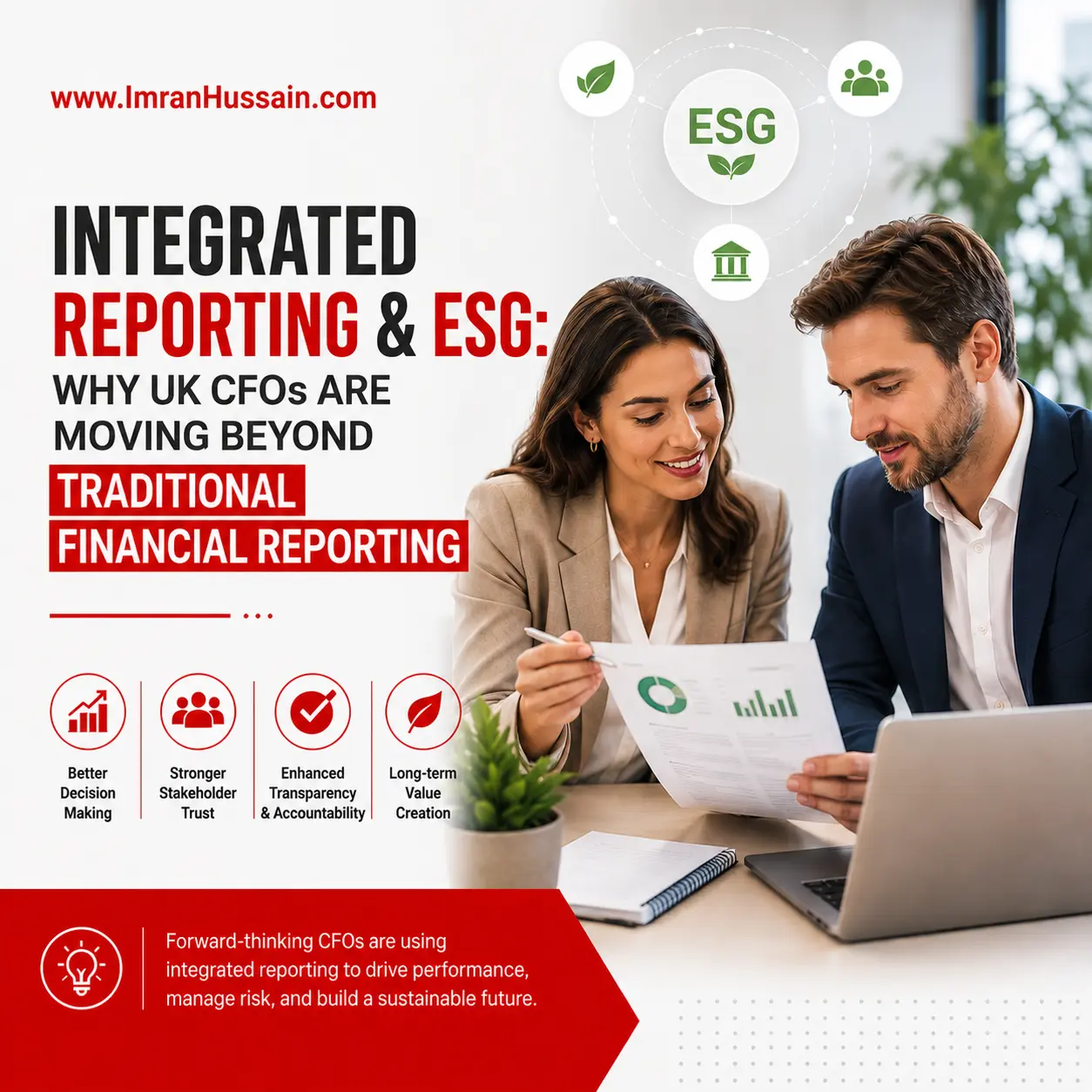
For decades, corporate reporting followed a familiar formula. Businesses published annual accounts, investors reviewed financial performance, and stakeholders assessed success largely through revenue growth, profitability, and cash flow.
That model is changing.
Today’s investors want to understand far more than last year’s numbers. They want insight into climate risks, workforce resilience, governance practices, supply chain sustainability, and the organisation’s ability to create value in a rapidly changing world.
This shift has elevated Environmental, Social and Governance (ESG) considerations from a corporate responsibility initiative to a boardroom priority. At the same time, integrated reporting has emerged as a practical framework for connecting financial performance with the broader factors that drive long-term business success.
For UK CFOs, this evolution presents a significant opportunity. Rather than viewing ESG reporting as another compliance burden, finance leaders can use integrated reporting to strengthen investor confidence, improve strategic decision-making, and demonstrate how the organisation creates sustainable value over time.
The most effective finance leaders are no longer asking whether ESG belongs in financial discussions. They are asking how quickly they can embed sustainability considerations into capital allocation, risk management, forecasting, and corporate reporting.
Financial statements remain essential, but they tell only part of the story.
A company can report strong profits while facing significant climate exposure. Another may achieve impressive revenue growth while struggling with employee retention or governance weaknesses. Traditional financial reporting often captures outcomes without fully explaining the underlying drivers that shape future performance.
This gap is becoming increasingly important as investors adopt longer investment horizons and place greater emphasis on organisational resilience.
Integrated reporting addresses this challenge by providing a broader narrative around value creation. Rather than separating sustainability information from financial performance, it demonstrates how strategy, governance, operations, and ESG factors interact to influence business outcomes.
For CFOs, this approach transforms reporting from a compliance exercise into a strategic communication tool.
The investment community has undergone a fundamental shift over the past decade.
Institutional investors increasingly evaluate businesses through both financial and non-financial lenses. They want evidence that organisations can navigate regulatory changes, environmental challenges, workforce expectations, and evolving stakeholder demands.
In many cases, ESG performance is viewed as a proxy for management quality.
Companies with strong governance structures, effective risk oversight, and clearly defined sustainability strategies are often perceived as better positioned to manage uncertainty and generate long-term returns.
This does not mean investors prioritise ESG over profitability. Rather, they increasingly see sustainability performance as interconnected with financial performance.
For CFOs seeking to attract capital, maintain shareholder confidence, or support future fundraising initiatives, integrated reporting provides an opportunity to articulate this connection more effectively.

One of the biggest misconceptions surrounding ESG reporting is that it primarily serves reputational objectives.
In reality, ESG factors are increasingly influencing financial outcomes across multiple areas of business operations.
Rising energy costs, climate-related disruptions, evolving employment expectations, supply chain vulnerabilities, and regulatory changes can all impact profitability and enterprise value.
As a result, ESG data is becoming increasingly relevant to forecasting, budgeting, investment analysis, and risk management.
This explains why finance teams are assuming greater ownership of sustainability reporting.
The CFO’s role is uniquely positioned at the intersection of strategy, risk, governance, and performance measurement. Integrating ESG considerations into these processes allows organisations to make more informed decisions while strengthening stakeholder confidence in reported information.
Many organisations still approach ESG reporting as a data collection exercise.
They gather emissions figures, diversity statistics, governance disclosures, and sustainability metrics primarily to satisfy reporting requirements.
The organisations gaining the greatest value, however, use ESG insights to inform strategic decisions.
Integrated reporting encourages this mindset by focusing on how sustainability factors influence future value creation rather than simply documenting historical performance.
When viewed through this lens, ESG becomes a business strategy discussion rather than a reporting obligation.
Questions around investment priorities, operational efficiency, talent retention, innovation, and long-term growth become closely connected to sustainability objectives.
This shift is where CFOs can have the greatest impact.
The future of corporate reporting is unlikely to involve separate conversations about financial performance and sustainability performance.
Stakeholders increasingly expect a unified view of organisational health.
For UK businesses, this means developing reporting frameworks capable of demonstrating how ESG initiatives contribute to resilience, competitiveness, and long-term value creation.
Successful CFOs are focusing on three priorities: improving ESG data quality, strengthening governance around sustainability disclosures, and embedding ESG considerations into financial planning processes.
These actions help ensure that reporting reflects business reality rather than simply satisfying disclosure requirements.
As expectations continue to evolve, organisations that establish integrated reporting capabilities today will be better positioned to respond to future regulatory developments and investor demands.
Integrated reporting represents more than a reporting trend. It reflects a broader shift in how business performance is measured and communicated.
For UK CFOs, the opportunity extends beyond compliance. Integrated reporting enables finance leaders to demonstrate how the organisation creates value, manages risk, and positions itself for long-term success in an increasingly complex business environment.
The companies that excel in the coming years are unlikely to be those that simply publish more ESG data. They will be the organisations that successfully connect sustainability, strategy, and financial performance into a coherent story that stakeholders can understand and trust.
That is precisely where integrated reporting delivers its greatest value.
Let’s connect! I share insights on business, leadership, and entrepreneurship. Find me on your preferred social media platform to stay in the loop and join the conversation. I look forward to connecting with you there.
Essential
Address
© copyright 2026 Imran Hussain All Rights Reserved
Terms & Conditions
Privacy Policy